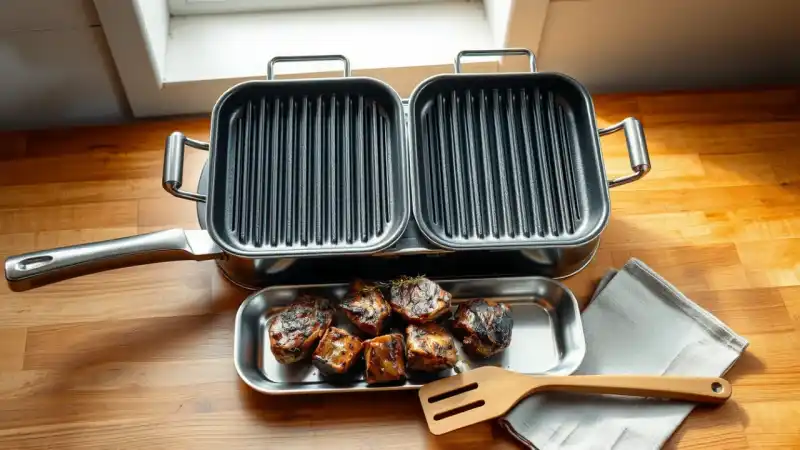
In 2012, magnetic flip pans were the kitchen gadget of the moment in Singapore. The flippable double-pan promised to grill, sear and fry food in a closed space, without the oily splatter of an ordinary pan. A road test that year put three of them through the same trial: the Standard Happy Call Pressure Pan, the Hankook St James Multipan and the Song Cho Stainless Steel Double Pan.
The tester cooked small chicken thighs and beef chunks in each pan. The pans were judged on how easy they were to flip, how securely they closed, how quickly they cooked and how much scrubbing they needed afterwards.
The three pans in 2012
Standard Happy Call Pressure Pan: 8.5 out of 10
This was the editor’s pick. At 1.5kg it was the lightest and the smallest of the three. It cost S$89 in 2012 and was sold at major department stores and supermarkets.
The straight handle made flipping easy, and the magnetic lock opened smoothly and closed tightly. Its ceramic and titanium coating made it the best non-stick performer: hardly anything stuck, and what did came off with a kitchen towel.
The chicken thighs cooked through in eight minutes. The beef took only three, possibly because the pan was already hot. Nothing burnt. The drawback was that the two halves could not be detached, which made washing in the sink awkward.
Hankook St James Multipan: 8 out of 10
This was named best value at S$49.90 in 2012, and it was sold at Metro, OG and selected Fairprice Xtra hypermarts. It weighed 1.7kg.
Its two halves detach, so each can be used alone as a grill or frying pan, and washing up was simple. The handle was the longest of the three. A button on it opens the pan, and pressing the button back into its slot closes it.
The chicken and the beef each took about eight minutes. Both cooked through without burning, and the nano-diamond coating left little residue. The tester did find it a strain to flip mid-cook. The wide rectangular shape was bulky to wash and store, and the hinges needed pushing back into place after the halves were separated. A light scrub with soap and water removed what the kitchen towel left.
Song Cho Stainless Steel Double Pan: 6.5 out of 10
This was the priciest pan. It cost S$148 on a promotion that ran to 31 December 2012, against a usual S$168. It was sold at Takashimaya D.S. and selected Metro, OG and Fairprice stores. It also weighed 1.7kg, but it felt light enough to use without strain.
It was made of multiple layers of stainless steel with no non-stick coating, and it was the only one of the three that worked on an induction cooker. The halves detach and work alone as a grill and a frying pan, and the inward-curving handles sat snugly in the hand.
The faults added up. The handle was short and the pan took up a lot of room on the stove. The detachable hinge came loose easily, so the halves had to be aligned carefully before closing. The chicken stuck and needed about eight and a half minutes. The beef took five. Cleaning meant heavy scrubbing with soapy water.
What can be found today
Happy Call is the one brand of the three that can be confirmed as still sold in Singapore. Department store Metro lists the brand on its website and recommends its Diamond Pan and double-sided pan. It says they are available at Metro Paragon and Metro Causeway Point.
The range has grown well beyond the 2012 model. Retailer listings now include graphene-coated and induction-compatible double pans, as well as jumbo sizes. That matters because induction compatibility was the one thing the 2012 Happy Call lacked and the Song Cho offered.
The 2012 prices, stockists and scores above belong to that year. Current availability and pricing for the Hankook St James and Song Cho pans could not be confirmed, so check with a retailer before planning a purchase.
What the test showed
The 2012 results turned on three practical points. Weight decided how easy a pan was to flip. A detachable design made washing easier but brought a fiddly hinge. A good non-stick coating mattered more than a lower price. The cheapest pan did well, and the dearest, uncoated one was the hardest to clean.