
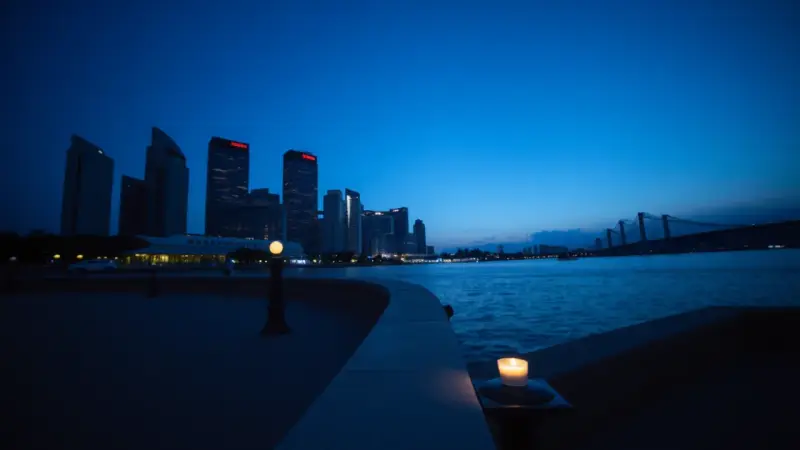
At 8.30pm on Saturday 31 March 2012, the lights went off across Singapore for Earth Hour. Shops, restaurants and an entire light festival joined in, and WWF Singapore collected donations from shoppers. That year’s local theme was the “I Will If You Will” challenge, where people promised to take an action if others matched it.
The ways to be part of Earth Hour that year included shopping with an eco-bag at Carrefour, eating in the dark at IKEA, watching iLight Marina Bay switch off, joining a human formation on Orchard Road and recycling empty containers at The Body Shop.
Shopping and dining in the dark
Carrefour Singapore pledged to raise S$10,000 for WWF Singapore. From 29 to 31 March 2012, between 7pm and closing time, shoppers were asked to buy a S$1 eco-bag rather than take plastic bags, and the money went to WWF Singapore. For those three days, the Carrefour stores at Plaza Singapura and Suntec City gave out no plastic bags at all.
IKEA turned off the lights in its restaurants at Alexandra and Tampines from 8.30pm to 9.30pm on the Saturday. All the money taken during that hour went to WWF Singapore’s local conservation and outreach work.
The Body Shop switched off the lights at all 37 of its Singapore outlets. It also signed up to the “I Will If You Will” challenge. From 31 March to 22 April 2012, every three recyclable containers brought to a store, from any brand, earned a 60ml shower gel. The brand also supplied products for the Earth Hour goodie bag, which went to people who signed up online as Earth Hour ambassadors.
Lights out at Marina Bay and Orchard Road
At iLight Marina Bay, all 31 featured artworks were switched off for the hour. From 6pm, the public could join a Mass Light Catcher Creation workshop at The Lawn. A commemorative light-up came afterwards, along with a free screening of Kung Fu Panda 2 at an outdoor movie night.
On Orchard Road, Earth Hour ambassadors lined up to spell out “60+ SINGAPORE”. The “+” stood for going further than the hour itself and keeping up sustainable habits afterwards. Participants were asked to bring candles made from beeswax or vegetable wax to light when the power went off at 8.30pm.
From one dark hour to the Biggest Hour for Earth
Earth Hour had already been in Singapore for some years by 2012. An earlier WWF Singapore programme for a 28 March edition was centred on the Botanic Gardens. It included a multimedia presentation of An Inconvenient Truth, a green carnival, a candlelit picnic and a concert by local bands. Celebrity ambassador Nadya Hutagalung and WWF Singapore managing director Amy Ho gave “switch off” speeches. The Astronomical Society of Singapore held a stargazing party at East Coast Park.
The idea of going “beyond the hour” became the main focus. In 2025, WWF-Singapore held its flagship Earth Hour festival at Sentosa Sensoryscape, linked to Singapore’s SG60 milestone and focused on water conservation. Thousands of people attended. Booths covered recycling, mindful consumption, coral restoration, the illegal wildlife trade and citizen science. More than 140 people took part in hands-on sessions such as assembling solar lights and preparing sustainable meals. A Switch Off Concert started at 6.30pm, with local artists, school choirs and dance groups.
Marina Bay Sands, Gardens by the Bay, iFly, the Maritime and Port Authority of Singapore and West Coast Community Centre switched off their lights that night. Watsons Singapore ran a bottle-recycling drive with eco-friendly rewards, much like The Body Shop’s container swap in 2012. Around the world, Earth Hour 2025 took place on 22 March. Participants gave nearly three million hours to environmental action, double the previous Earth Hour record.
WWF-Singapore also supported a coral restoration study led by the National University of Singapore’s Tropical Marine Science Institute. The project planted 1,168 coral fragments along a stretch of reef in the Southern Islands of about 330m. WWF-Singapore and the institute trained 27 volunteers as citizen scientists to help with the work.
Earth Hour 2026 marked the movement’s 20th anniversary and was set for 8.30pm local time on Saturday 28 March 2026. WWF-Singapore also ran an Earth Hour Virtual Run 2026 to celebrate 20 years of collective action for climate and nature. The run raised support for programmes that protect wildlife, restore habitats and build climate resilience.