
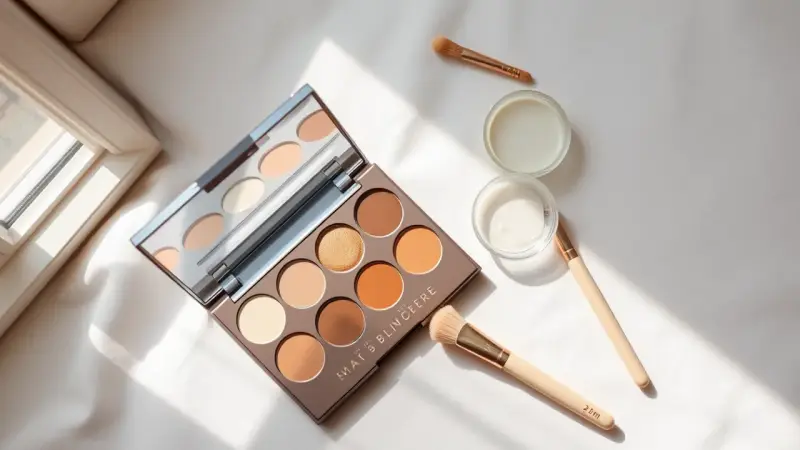
Where your eyeshadow sits matters as much as the colour you choose, because the way your eyelids move changes what shows. On single eyelids and hidden double eyelids, colour placed in the natural crease disappears under the fold once the eye opens. So for these lid types, place colour higher, and apply and check it with your eyes open.
Below are four routines, one each for double, uneven, hidden double and single eyelids. Start every routine with a thin layer of eyeshadow primer set with a light, skin-toned shadow, because deep folds tend to collect shadow and make it crease.
Double eyelids
A visible crease leaves plenty of room for colour, so choose shades that suit your skin tone. Brown, plum and khaki green all work well.
- Sweep a light shade over the whole lid, fading it out towards the brow bone.
- Dab a darker shade on the outer corner and blend it inwards until it covers a third of the lid.
- Dust plum or brown over the outer third, keeping it below the fold, and along the outer half of the lower lash line.
- Line the eyes close to the upper lashes.
Uneven eyelids
When one lid has a crease and the other doesn’t, use eyeliner rather than shadow to even them out.
- Sweep a highlighter shade from the lash line to the brow bone.
- Blend a darker shade over the lids only, to add dimension.
- On the single eyelid, keep the eye open and dot liner along the lash line. Then join the dots and fill in the gaps.
- On the double eyelid, keep the liner just below the fold. When both eyes are closed, the line on the single eyelid will look thicker, which is intended: with the eyes open, the fold covers part of that line, so both eyes show a similar amount of liner.
Another way to balance uneven lids is to blend your transition shade slightly higher on the smaller or more hooded eye. Matte finishes make an area recede and shimmer brings it forward, so you can use both to fine-tune the match.
Hidden double eyelids
Here the crease exists but sits tucked under the skin, so blend colour higher up on the eye socket, where it stays visible.
- Starting at the lash line, blend a light shade up over the socket, stopping below the brow bone.
- Apply a darker shade to the outer third of the lid and blend it upwards onto the socket.
- Line from the inner corner, extending the liner so its outermost point just touches the fold. The finished line should look like a narrow triangle.
- Pat a little light shimmer onto the centre of the lid so the eyes look bigger.
Single eyelids
Deeper colours used close to the lashes make single eyelids look bigger and wider.
- Using a thin liner brush, press dark brown shadow along the upper lash line from the inner corner, then smudge it lightly into a soft, blunt line.
- Brush the same brown along the lower lash line, working from the outer corner inwards.
- Layer a medium shade such as cobalt blue or purple over the brown and blend, adding more on the outer third.
- Looking straight into the mirror, mark the highest point of your upper lash line with eyeliner. Draw the line from the inner corner to that mark, then extend it outwards parallel to the ground.
Applying the shade in a horizontal gradient also suits single and hooded lids. Keep the darkest colour on the outer third and fade lighter towards the inner corner, instead of stacking dark colour at the lash line and lightening it towards the brow. A dark colour taken all the way across the lid can make the eyes look heavy.
FAQ
– Why does my eyeshadow disappear when I open my eyes?
On single and hooded eyelids, the lid folds over colour placed in the natural crease. Blend the shade above the fold, checking in the mirror with your eyes open, so it stays visible.
– What eyeliner works for hooded or single eyelids?
Tightlining (pressing liner into the upper lash line) and waterlining define the eyes without taking up any lid space. If you wear a wing, draw it with your eyes open so it allows for the fold.