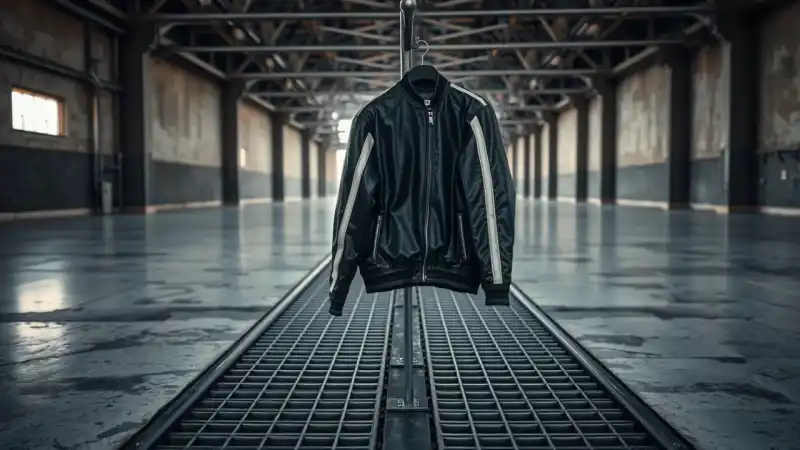
On 18 October 2013, the Tokyo menswear label 99%IS sent out its Spring Summer 2014 collection at Japan Fashion Week. Designer Bajowoo dropped the studs and spikes that had marked his earlier work. In their place came black, white and chrome silver leather, and bold white stripes that looked like something from an early-1960s prison film.
That stripe story is what people remember from the show. Restrained stripes sharpened the tailoring. Bands of white on black from top to toe gave the “prison couture” look.
A streamlined take on rebel dressing
The show opened with Bajowoo’s own version of the classic blazer. The 99%IS cut was oversized and had leather panels. From there the collection moved through the staples of rebellious pop culture:
- the motorcycle jacket
- the 1960s Mod coat
- the skinhead’s flight jacket
- the oversized hip-hop T-shirt
The first of these looks were all in black. Chrome silver leather then lightened the mood, which suited a spring and summer season. After that came pieces in similar shapes with wide white stripes.
Why the stripes worked
The collection used stripes in two ways. Used sparingly, they traced the line of a jacket or trouser and showed off the cut. Used head to toe, they made a costume. Bajowoo’s wider punk vocabulary treats the outlaw as a figure of style, so the prison reference fitted with the rest of the show.
The result was a tight, focused collection that stayed true to the label’s character while stripping away its most obvious trademarks.
The audience and the designer
Some in the audience had hoped for a K-pop star or two to appear. None did, although plenty of Japanese stylists, who dress the country’s biggest celebrities, were there. The label already had famous followers. Big Bang’s G-Dragon and Daesung had worn it, and Lady Gaga had worn it through her stylist, Nicola Formichetti.
Bajowoo was born in Seoul in 1984. After studying at Esmod Korea from 2003, he started what was billed as Korea’s first punk brand and made costumes for rock bands. He then spent time in London, Paris, Tokyo and Bangkok. He moved to Tokyo in 2008 and enrolled at the Dressmaker fashion school in 2010. The official Tokyo fashion week page says he founded 99%IS in the autumn/winter 2012 season, when he was a second-year student, and it dates his runway debut to the Spring Summer 2013 shows. Other retailers give 2011 as the founding year.
The name comes from Bajowoo’s own explanation. There is a 1 percent of culture that most people ignore, he has said, but for him and his friends it is their 99 percent.
What came next
The label kept building its reputation. In an Autumn Winter 2014-15 collection called “Always”, it stuck to its punk-rock roots and mixed fine tailoring in light wools and worsteds with leather, vinyl and rubber. In 2016 Bajowoo showed at Seoul Fashion Week. There, according to Koreaboo, models drank, smoked and wore bondage and plastic bags, in contrast to the usual elegance of the event. He told Vogue that year that he wanted to establish an Asian fashion identity rather than head to New York or Europe.
By 2019 Coveteur was calling it a Korean brand to watch. It pointed to parachute-style track pants with elastic pulls, known as the Gochang Pant. It listed wearers including Billie Eilish, A$AP Rocky and Skepta. The label has also worked with Comme des Garçons, George Cox and Mackintosh, according to its Tokyo fashion week profile.