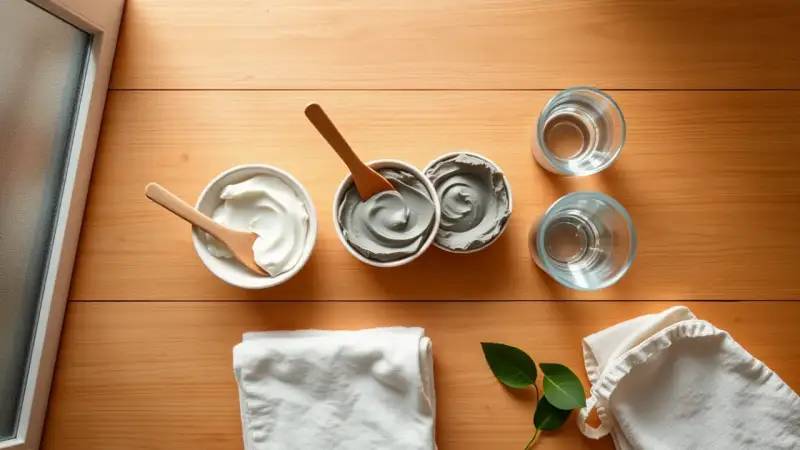
Anyone who already layers toners, serums and creams will find that using mud based masks alongside other masks follows one simple rule. The rinse-off mask goes on first, and the clay or mud mask goes on last.
Two pairings put that rule to work. A hydrating mask followed by a mud mask suits flaky, breakout-prone skin. A brightening mask followed by a clay mask suits skin that is dull and oily at once.
Why do mud and clay masks go last?
Nicolas Travis, founder of the Singapore grooming brand Allies of Skin, has explained the problem. A thinner emulsion applied over a mud mask cannot properly get through the paste. Clay forms a dense layer on the skin, so whatever sits underneath it is sealed in, while whatever goes on top has little chance of reaching the skin.
The same reasoning explains the usual label advice on clay masks, which is to finish with a toner. Heavy kaolin particles can cling, and a toner helps lift the last traces from the face.
How do you choose which masks to combine?
Start by listing the concerns, then match them in two steps. A cream or lotion-type mask handles hydration and fine lines. A detoxifying clay mask then draws excess oil and impurities out of the pores. Each mask has its own job, so the two do not compete.
Rinse the first mask off fully before the clay goes on. Layering them in the right order is what lets each formula do its work.
What helps flaky skin that also breaks out?
Many acne treatments dry the skin, which leaves painful spots alongside peeling. The two-step answer is to hydrate first and then treat the blemishes.
Begin with a moisturising mask built around soothing ingredients. Fresh’s Black Tea Instant Perfecting Mask is one example. It combines a black tea ferment with lychee seed and jicama root juice. Leave it on for a while, then rinse.
Follow with a blemish-targeting mud mask. GlamGlow’s Thirsty Mud Hydrating Treatment is one option, with oats, olive leaf, orange blossom honey and hyaluronic acid in the formula.
If peeling is severe, apply the mud mask only to the acne-prone zones, such as the cheeks and chin. This tackles oil and congestion where they occur without irritating the more sensitive areas.
What about dull skin that is also oily?
For skin that looks tired and shiny together, brighten first and mattify second. A gently exfoliating gel mask works well as the opening step. Peter Thomas Roth’s Rose Stem Cell Bio-Repair Gel Mask is an example of a product marketed for that purpose, with stem cell-based actives and a light fragrance.
Rinse it off, then apply a clarifying clay mask to absorb sebum. Fresh’s Umbrian Clay Mattifying Mask is one such formula, built around a mineral-rich clay that is meant to purify pores.
A custom touch is to stir a little ceramide cream into the clay before applying it. This is a personal tweak rather than a rule. It may soften the clay’s drying effect, though it will also change the mask’s texture.
Are there other combinations worth trying?
These two pairings are only examples. The same logic works for any combination. Put the mask aimed at hydration, brightening or soothing first, and keep the clay product for last. Because clay can be drying, applying it only to oilier areas such as the forehead, nose and chin is a sensible way to match the mask to each part of the face.
Anyone with very sensitive skin, or skin that is reacting to acne medication, should test a new mask on a small area first. Limiting how often masks are layered also helps, since stacking several strong formulas close together can irritate.
Check the instructions on each product for timings, because leave-on times differ between gel, cream and clay masks.