
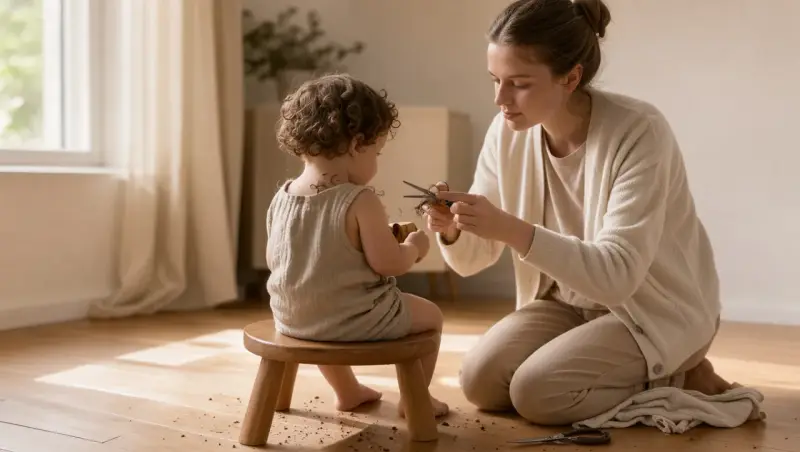
A toddler curly hair cut goes best when you trim less than you think you need, cut in small sections, and use sharp scissors instead of a razor. Curls shrink as they dry, so a small snip on stretched hair can look like a big change once the curls spring back. Cutting dry, or on styled curls, shows the true shape first.
The right approach also depends on your child’s curl pattern, how long they will sit still, and the style you want. That might be a simple shape-up, a taper that keeps curls full on top, or longer curls protected in puffs or braids.
How do you cut a toddler’s curly hair at home?
Cutting a toddler’s curly hair at home means preparing the space first, dividing the hair into sections, and taking off small amounts while checking how the curls fall. Speed matters less than control, because a toddler can move suddenly.
What you need
- Sharp hair-cutting scissors. Dull or kitchen scissors can fray the ends, and razors can cause frizz and loosen curl definition.
- A wide-tooth comb. It parts and detangles without stretching curls as much as a fine-tooth comb.
- Duckbill clips. These hold finished or uncut sections out of the way.
- A spray bottle. A light mist keeps damp hair manageable if you cut slightly wet.
- A cut-open trash bag or old sheet. Spread it on the floor and seat your child in the middle for easy cleanup.
- Distractions. A show, snacks or a favorite toy can buy you a few calm minutes.
- Clippers with guards (optional). These are useful for tapered sides or a short crop.
Step-by-step
- Detangle and style first. Wash, condition and style the curls the way your child usually wears them, so you cut the shape you will actually see.
- Look at the overall shape. Before cutting, note uneven spots, straggly ends and any area that sticks out.
- Section the hair. Split it into quadrants or smaller sections and clip away everything except the section you are working on.
- Start at the bottom. Work from the nape upward, so the lower layers act as a guide for the ones above.
- Cut curl by curl or with a guide. Hold a curl between your fingers and snip only the frayed end, or match each section to a guide section you cut first.
- Check after each section. Let the curls drop and compare both sides before moving on.
- Finish around the face last. Bangs and face-framing pieces shrink the most visibly, so leave them longer than you think and trim a tiny bit at a time.
If your toddler gets restless, stop and finish another day. A half-done trim on curly hair is easier to blend later than a rushed, uneven cut.
Should you cut toddler curly hair wet or dry?
Toddler curly hair is usually easier to cut accurately when it is dry or styled with curl product, because you can see the real curl pattern and how much it shrinks. Wet curls hang longer and straighter, which makes it easy to cut off too much.
Lightly damp hair has one advantage with toddlers: it is calmer and less likely to puff out if your child wiggles. A middle-ground method is to cut on styled curls, then mist a section lightly only when it gets frizzy or hard to hold. Whichever you choose, work in small sections and cut conservatively.
Toddler curly haircut styles for boys
Popular toddler curly haircut styles for boys keep length where curls look fullest, usually on top, and shorten the areas that tangle or get sweaty, such as the sides, ears and nape. Clipper guard numbers refer to the length left on the head; a higher number leaves longer hair.
| Style | What gets shortened | Curls left longest | Upkeep |
|---|---|---|---|
| Taper or burst fade | Around the ears, nape or sides | Top and crown | Sides need regular touch-ups to stay neat |
| Curly top | Sides, blended or tapered | Top | Moderate; top needs detangling |
| Mullet or wolf cut | Sides, blended or tapered | Top and back | Moderate; longer back can tangle |
| Short buzz or textured crop | All over, often with a longer guard such as #4 or #5 | Even short curls throughout | Low; little tangling |
For a first try at home, a scissor trim that only cleans up ends is the most forgiving option. Fades and tapers take more clipper control, so a barber who works with curly hair may be the better choice for those.
Toddler curly hair cuts for girls
Toddler curly hair cuts for girls often focus on keeping length while removing split or tangled ends and evening out the shape. Small trims curl by curl work well here, since a little shape-up keeps curls defined without losing length.
Many curly styles for little girls depend less on the cut than on how the hair is worn. Low-fuss options include:
- Mini puffs. Small gathered puffs keep curls off the face and are quick to redo.
- Twist-outs. Twisting damp hair and unraveling it once dry gives defined curls with little daily work.
- Braided ponytails or box braids. These protective styles help reduce tangles and frizz between wash days.
- Cornrows. Close-to-the-scalp braids keep hair neat for active toddlers.
Keep braids and ponytails loose enough that they do not pull at the hairline, since a toddler’s hair and scalp are delicate.
How often should you trim a toddler’s curly hair?
A toddler’s curly hair does not need a strict trim schedule. Cut it when the ends look straggly, split or uneven, when tangles keep forming at the ends, or when you want to change the shape or style.
Those two reasons, a new style or hair that needs a cleanup, are a simple way to decide. If the curls look healthy and your child likes the length, waiting is fine. Short clipper styles like fades need more frequent touch-ups than longer curls to keep their shape.
Aftercare for a toddler’s curly haircut
Aftercare for a toddler’s curly hair is about moisture and gentle handling, so the fresh ends stay smooth. A few habits help the cut look good longer:
- Detangle with conditioner. Work from the ends up with fingers or a wide-tooth comb while hair is coated in conditioner.
- Use gentle, kid-friendly products. Choose mild cleansers and light leave-ins rather than heavy styling products.
- Patch test new products. Apply a small amount to a small patch of skin, such as behind the ear, and wait before using it on the whole head. Stop if you see redness or irritation.
- Protect curls at night. A satin or silk pillowcase can reduce friction and frizz.
- Skip heat. Air-drying protects curl definition on young hair.
See a pediatrician or a dermatologist if your child has a persistent rash, flaking, sores, itching or patches of hair loss on the scalp. Those are not haircut problems and need a medical opinion.
Common mistakes when cutting curly toddler hair
- Cutting stretched wet curls. Wet curls look longer than they are, so the dry result ends up shorter than planned.
- Using a razor or thinning shears. These can leave frizzy, undefined ends on curly hair.
- Cutting bangs straight across on wet hair. Curly bangs can shrink up and look uneven once dry.
- Trying to finish in one session. A squirmy toddler and sharp scissors are a risky mix; stop and come back later.
- Chasing perfect symmetry. Individual curls spring differently, so judge the overall shape rather than single strands.
FAQ
– Can you use clippers on toddler curly hair?
Yes, clippers work on toddler curly hair, especially for tapered sides or a short crop. A longer guard, such as #4 or #5, keeps curls short but still visible. Start with a longer guard than you think you need, because you can always go shorter.
– Does cutting a toddler’s hair make it curlier or thicker?
No, cutting a toddler’s hair does not change the curl pattern or how thick it grows, because that comes from the hair follicle, not the ends. A fresh cut can make curls look bouncier, though, because removing weight and split ends lets them spring up more.
– Should a toddler’s first curly haircut be at a salon?
A salon or barber is a good choice for a toddler’s first curly haircut if you want a fade, taper or defined shape, or if you are nervous about cutting. Look for a stylist who regularly cuts curly hair and asks how your child wears it. A simple end trim is manageable at home.
– How do you keep a toddler still for a haircut?
Keeping a toddler still for a haircut works best with a setup ready before you start and a distraction they enjoy, such as a show, snack or toy. Seat them where you can reach every side, keep sessions short, and pause if they get upset.